The Pattern Is Tightening

by Michael Hollister
Exclusive published at Michael Hollister on June 03, 2026
4.628 words * 22 minutes readingtime
For a compact entry into the topic: the briefing accompanying this analysis summarizes the four central developments in ten minutes of reading time – The Pattern Is Tightening
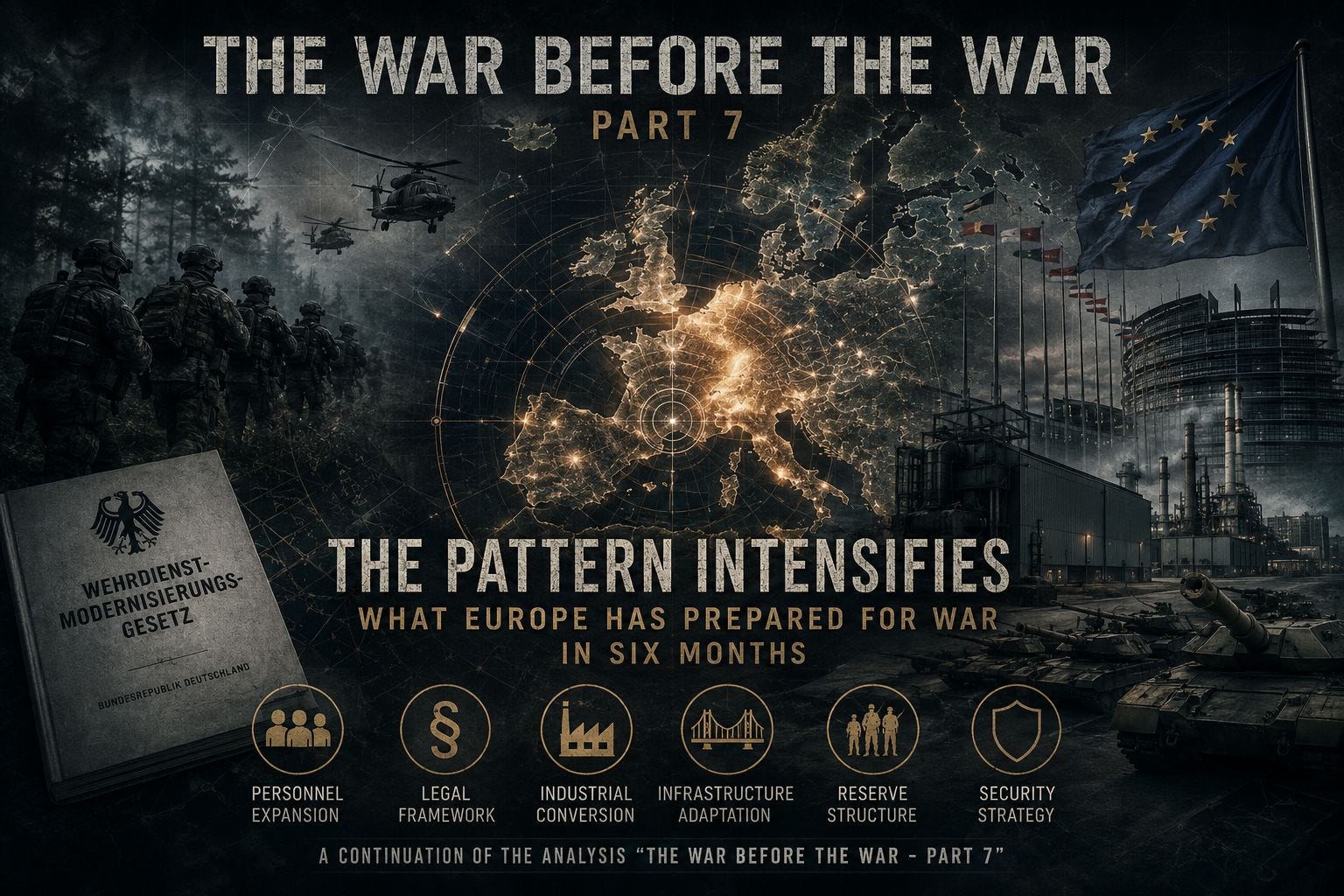
A continuation of the analysis “The War Before the War – Part 7“
Exclusive Analysis for Supporter
What Europe Has Prepared for War in Six Months
In May 2026, German special forces are practicing the killing of Russian generals in the Lithuanian forest. Not abstractly, not conceptually - but for three weeks, “as close to reality as possible,” as Brigadier General Torsten Glockzin puts it. The training scenario is precise: Russia has occupied the Baltic states, twenty days after the outbreak of war. Estonia and Lithuania are partially in enemy hands. NATO has lost air superiority over the operational area. The Kommando Spezialkräfte - the KSK, Germany’s Special Forces Command - is operating behind enemy lines: identifying high-value targets, preparing precision strikes, destroying radar installations, power pylons and bridges, capturing enemy defectors.
The adversary is named in no official statement. No one need name it.
In “The War Before the War - Part 7,” sixteen steps were documented through which Europe transformed itself between 2014 and 2026 from a peacetime order into a state of war readiness - without a formal decision, without parliamentary consent, without the public perceiving it as a whole. The thesis was: wars do not begin with the first shot. They begin with the systematic removal of all obstacles that have so far prevented it. Treaties are cancelled, infrastructure adapted, industries converted, language shifted.
Six months after the conclusion of that article, the question arises that every good thesis provokes: does the pattern hold - or was it an over-interpretation? The answer this article provides is not a comfortable one. The pattern has not held. It has tightened.
Personnel First
Since 01 January 2026, all 18-year-old men and women in Germany receive a Bundeswehr questionnaire. For men, completing it is compulsory. Those born after 2008 will be progressively subject to mandatory fitness assessment again - from mid-2027 this is to apply across the board. In March 2026, the Bundestag’s Military Commissioner, Hennig Otte, reported that personnel growth, alongside material equipment and infrastructure, remained the “central challenge” for the Bundeswehr. Should the voluntary New Military Service fail to attract sufficient numbers, a “return to conscription would be the logical next step.”
That sounds like bureaucratic administration. It is more. After a fifteen-year pause, the state is rebuilding a reliable picture of who is militarily usable, where these people are, and whether they are deployable. The target figure legally enshrined in the Military Service Modernization Act is: 460,000 soldiers by 2035 - 260,000 active, 200,000 in the reserve. This is not a procurement program. It is mobilization planning in peacetime.
For the case that voluntary uptake is insufficient, the legislature has made provision. A “contingency conscription” provision is anchored in the law - activatable by a simple Bundestag resolution, without an amendment to the Basic Law, without long lead time. The Bundestag decides by statute, in particular if “the defense-policy situation or the personnel situation of the armed forces so requires.” That sentence appears verbatim in the current Military Service Act.

What caused brief political uproar in spring 2026 was a different paragraph from the same law. Section 3(2) of the Military Service Act stipulates that male persons from the age of 17 must obtain authorization from the responsible Bundeswehr career center if they wish to leave Germany for more than three months. The provision is not new - it dates from the Cold War era and was practically relevant until 2011 for as long as conscription applied. It was reactivated by the Military Service Modernization Act without this being publicly communicated to any great extent. When the press discovered it in spring 2026, the Ministry of Defense responded with a general administrative ruling: as long as military service remains voluntary, authorization is deemed granted.
The legal basis, however, remains. In a crisis it can be activated without enacting new legislation. That the state has reactivated it is not the news. The news is that it needs it again at all - and that the public would not have noticed had the press not investigated.
In April 2026, the Federal Ministry of Defense published its “New Reserve” strategy. Reservists are in future to protect critical infrastructure, secure logistical hubs, keep transit routes open, and - within the framework of the Germany Operations Plan - serve as a buffer between civilian society and front-line deployment. 200,000 reservists alongside an active force of 260,000 - that is not an army for overseas missions. That is an army for national defense.
The Military Security Enabling Act, which the Bundesrat also passed in December 2025, rounds out this framework. It creates legal foundations for the deployment of the Bundeswehr and the reserve inside Germany, for the protection of military installations, and for cooperation between military and civilian authorities in a crisis. The personnel build-up path is legally prescribed, verifiable, and backed by concrete annual milestones. When a state legally stipulates how many soldiers it must have in which year, and links this statute to an activatable form of conscription, that is not rhetoric. That is planning.
Then the Command
On 06 February 2026, the NATO Allies agreed on a redistribution of the Alliance’s military command structure. The structural significance of this decision can scarcely be overstated - and it was treated in the German public sphere largely as a footnote.
All three of NATO’s Joint Force Commands - the actual war commands at the operational level, which in crises and conflicts coordinate the conduct of warfighting - are passing under European leadership. Joint Force Command Norfolk in Virginia goes to the United Kingdom, Joint Force Command Naples goes to Italy, and Joint Force Command Brunssum in the Netherlands will be shared by Germany and Poland on a rotation basis. As early as February 2026, it was reported that Polish General Wieslaw Kukuła would succeed German General Ingo Gerhartz as commander in Brunssum. For the first time, all three operational NATO war commands will be led exclusively by Europeans.
The United States is relinquishing these positions - and retaining in exchange all three Theater Component Commands: land forces, air forces, naval forces. The post of Supreme Allied Commander Europe, NATO’s highest military commander in Europe, also remains American. The logic is transparent once stated: Europe takes on operational warfighting, America retains strategic control. For Washington, this is a politically convenient relief measure vis-à-vis a Trump who publicly describes European NATO members as free-riders. For Europe, it is a commitment from which one does not easily withdraw.
In parallel, a bilateral treaty architecture is forming at the national level that Polish commentators have already described as a “NATO within NATO”. Poland has signed defense agreements with France (Nancy, May 2025), the United Kingdom (RAF Northolt, May 2026) and - planned for June 2026 - Germany within twelve months. The United Kingdom has in turn concluded agreements with France, Germany and the EU, repositioning itself as an independent European security power. Prime Minister Donald Tusk explains Poland’s strategy without circumlocution: in an emergency, one wants a rapid response from Paris and London before the Alliance can convene in full session.
In plain terms: the bilateral agreements are explicitly designed to bypass the slow NATO decision-making processes. Article 5 continues to apply. But the tighter core acts faster, without having to wait for the consensus of all 32 members - and without having to involve the United States, which under Trump has declared it will no longer necessarily stand in for Europe. Legally it remains NATO. Politically, an alliance within the Alliance is emerging that does not conceal its geographic orientation.
In February 2026, it was also announced that the 1st German-Netherlands Corps based in Münster will in future lead NATO land forces in Estonia and Latvia. Up to 60,000 soldiers can be subordinated to the Corps. Command structures must be built before the conflict - in an emergency there is no time for that.
Money Without a Brake
The financial framework sustaining these developments is no less significant than the operational measures. In December 2025, the 2026 Budget Act was promulgated in the Federal Law Gazette. Germany’s defense expenditure rises to 108.2 billion euros - the highest level since the end of the Cold War. Of that, 47.88 billion euros flow into military procurement, 14.8 billion euros into ammunition alone, and 7.56 billion euros into equipment maintenance. Compared to 2024, when Germany spent 52 billion euros on defense, this represents a doubling within two years.
This is made possible by a constitutional amendment in force since 2025: defense expenditure above one percent of GDP is permanently exempted from the debt brake - as is expenditure on civil defense, intelligence services, IT security, and support for states attacked in violation of international law. The Federal Ministry of Finance put the credit-financed special component alone for 2026 at 98 billion euros. “The threat situation takes precedence over the budget situation,” Defense Minister Pistorius put it. When a state amends its constitution to permanently decouple arms expenditure from fiscal constraints, that is no longer fiscal policy. It is a prejudgment.
At the European level, the SAFE instrument flanks this course. 150 billion euros in low-interest loans with maturities of up to 45 years are available to EU member states for joint arms procurement. Ukraine and Canada may participate in the procurement procedures - a decision that would under normal circumstances require explanation if the objective were truly only EU self-defense. In February 2026, the defense ministers of Germany, France, the United Kingdom, Poland, and Sweden signed an agreement for the joint production of drones and loitering munitions with a range of 310 miles (500 km) - interoperable, jointly maintainable, jointly further developed. “That is important in view of the challenges that lie ahead of us,” said Pistorius.
The SAFE instrument is flanked by the European Defence Industry Programme EDIP, which provides a further 1.5 billion euros in direct grants for defense production through 2027. The EU Commission speaks openly of 800 billion euros that could be mobilized in total for European defense - an amount that exceeds the entire NATO defense expenditure of the past decade. The Commission’s Readiness Roadmap 2030 names four strategic priorities: Eastern Flank Watch, European Drone Defence Initiative, European Air Shield, and European Space Shield. Whoever can assign four of the five priorities geographically or functionally to a single possible adversary understands against whom this architecture is designed.
The Hub Becomes Real
On 29 January 2026, two combat battalions of the German Army - the Panzergrenadier Battalion 122 from Oberviechtach and the Panzer Battalion 203 from Augustdorf - were subordinated to Armored Brigade 45 “Lithuania” in Veitshöchheim. A few days later, on 04 February 2026, the multinational Battlegroup Lithuania followed with a public parade in Kaunas. The brigade now counts around 2,800 soldiers, 1,800 of them already stationed in Lithuania. By end 2027 it is to be fully operational with more than 5,000 soldiers and 200 civilian staff. The barracks in Rūdninkai is under construction.
Exclusive Analysis for Supporter
Europe is no longer merely talking about preparing for a possible major war. Over the past six months, personnel structures have been reactivated, command chains reorganized, defense spending detached from fiscal limits, Germany expanded into a military logistics hub, arms production dramatically increased, and civilian infrastructure integrated into national defense planning. This analysis shows how seemingly separate measures now form a visible pattern: a European security architecture no longer focused on abstract deterrence, but on concrete warfighting capability. A continuation of “The War Before the War – Part 7”.

